

Monumental Pair of Japanese Cloisonné Porcelain Jars, Takeuchi Chubei, Meiji
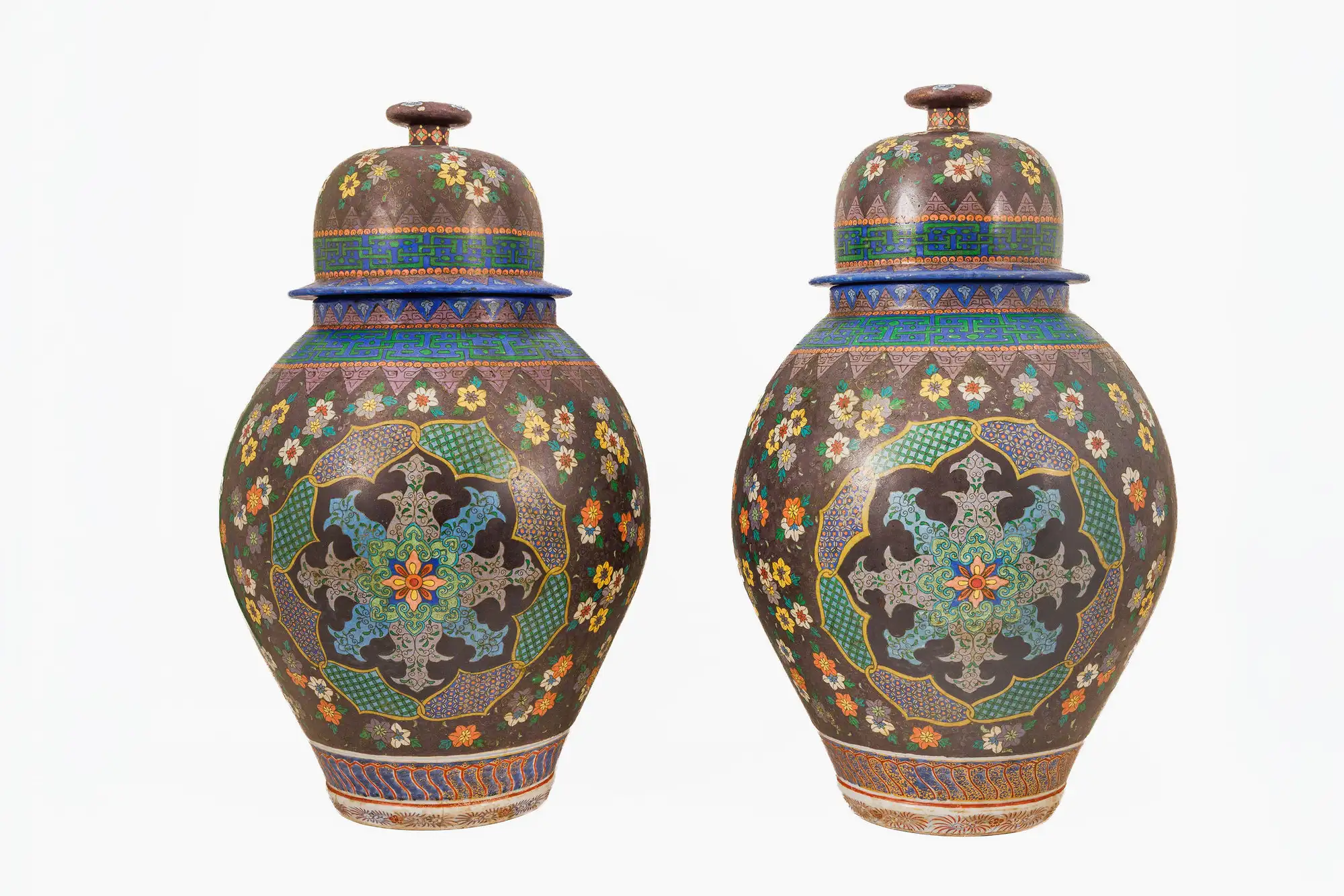
- An exceptionally rare and monumental pair of Japanese cloisonné enamel on porcelain covered jars, attributed to the celebrated Meiji-period enameler Takeuchi Chubei (竹内忠兵衛), associated with the important Shippo Gaisha workshop, circa 1875–1885.
- These magnificent covered jars represent an extraordinary achievement in Japanese decorative arts during the early Meiji period. Their monumental proportions, exceptionally elaborate polychrome decoration, unusual porcelain construction, and remarkable state of preservation as a matched pair distinguish them as important examples of nineteenth-century Japanese craftsmanship.
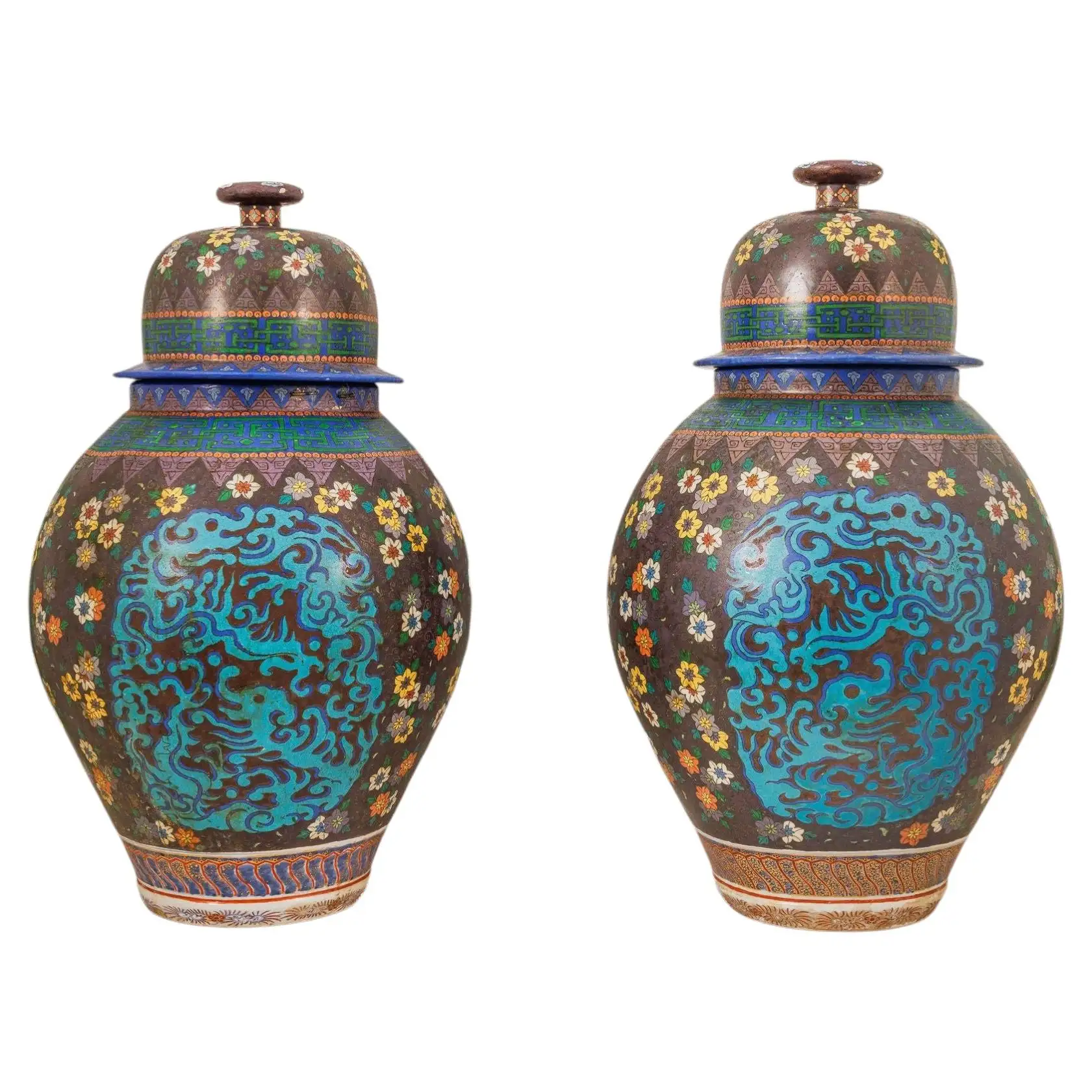
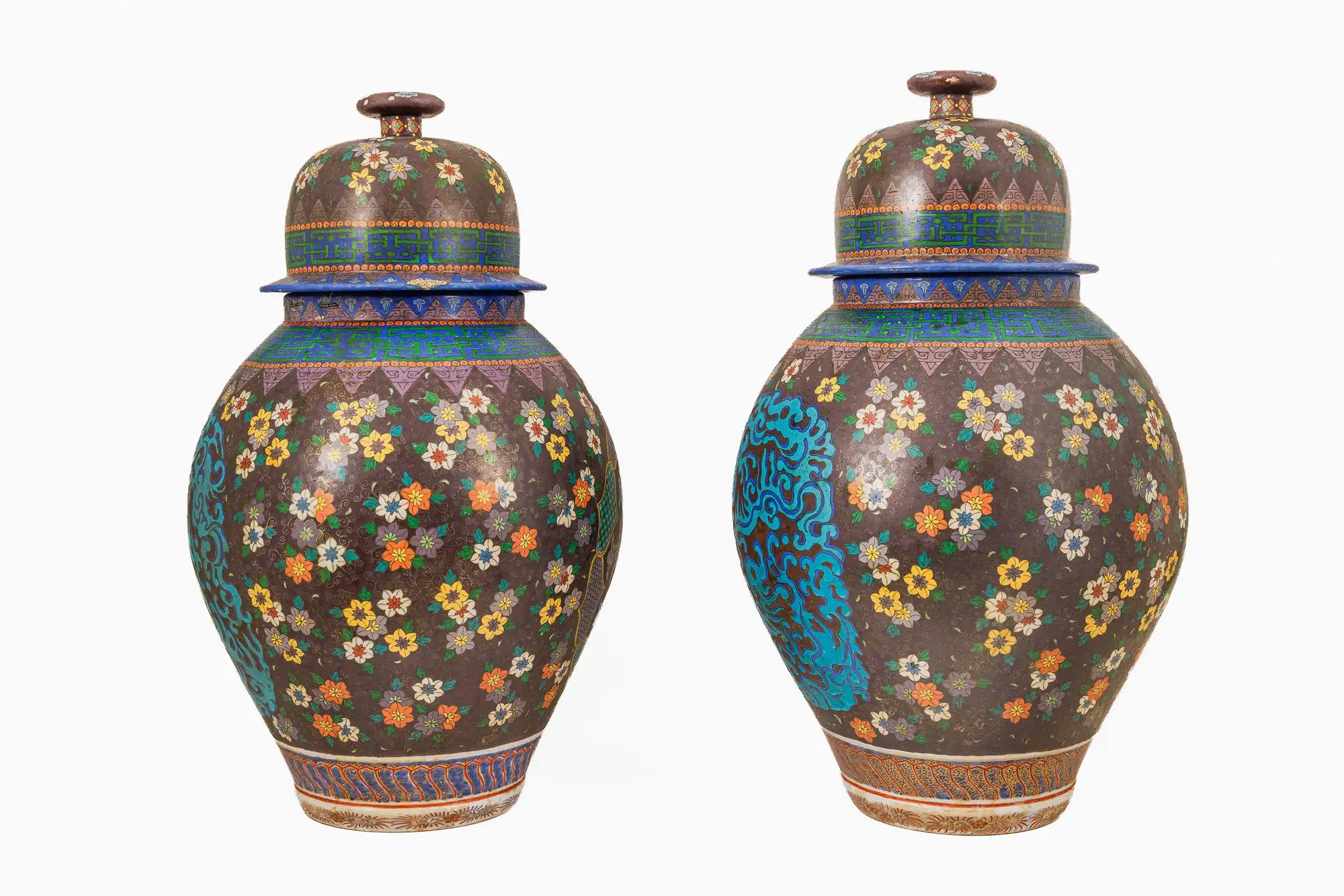
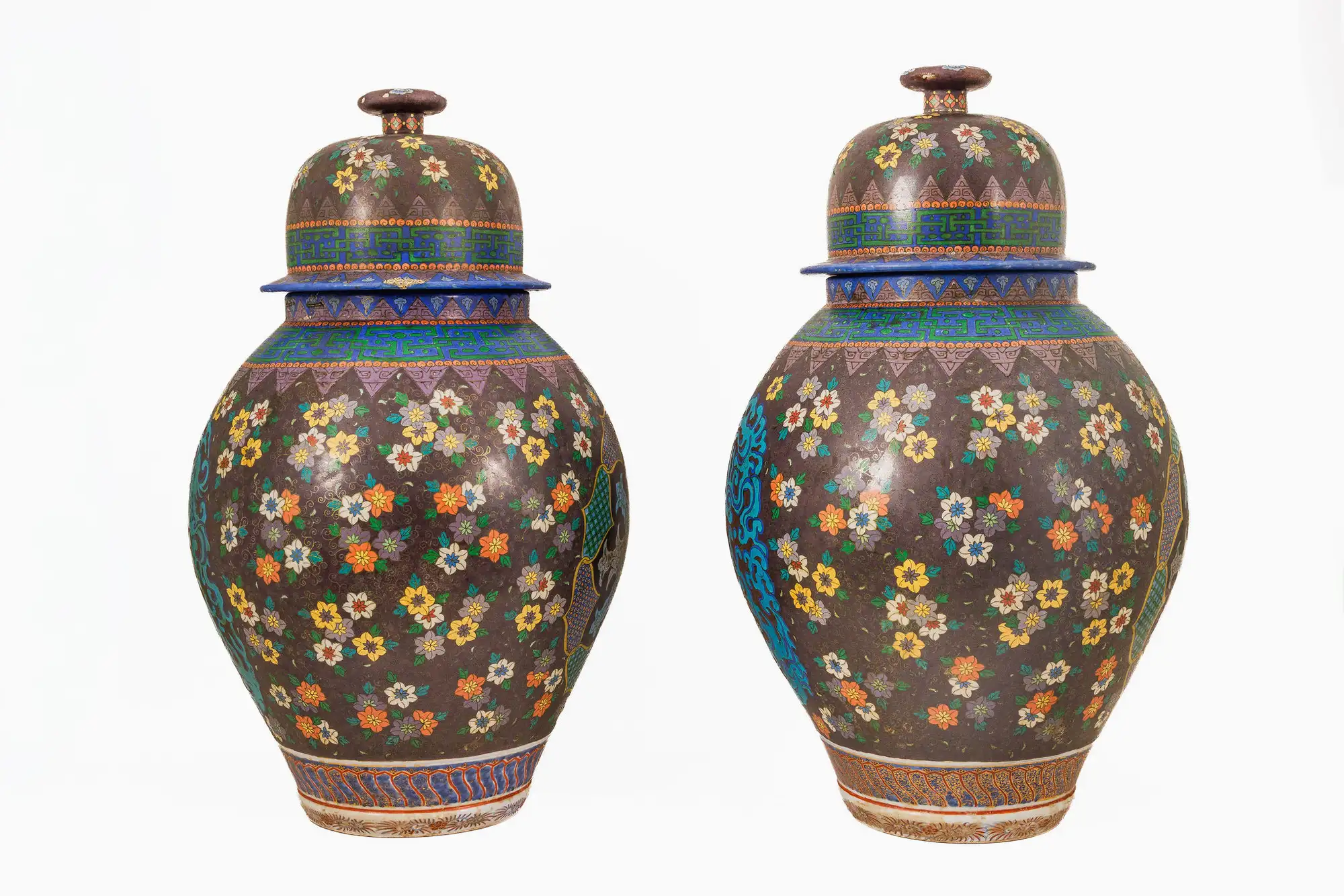
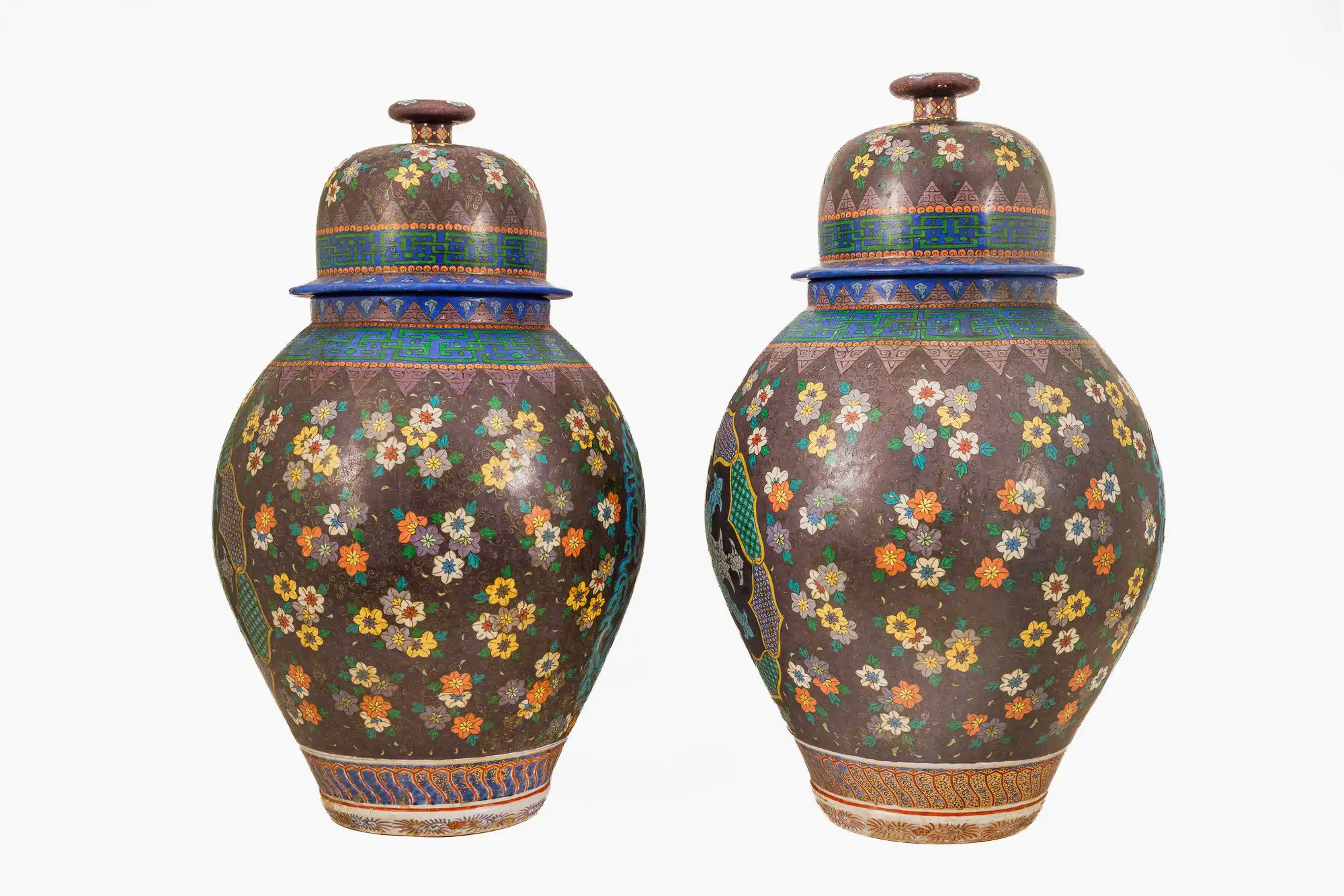
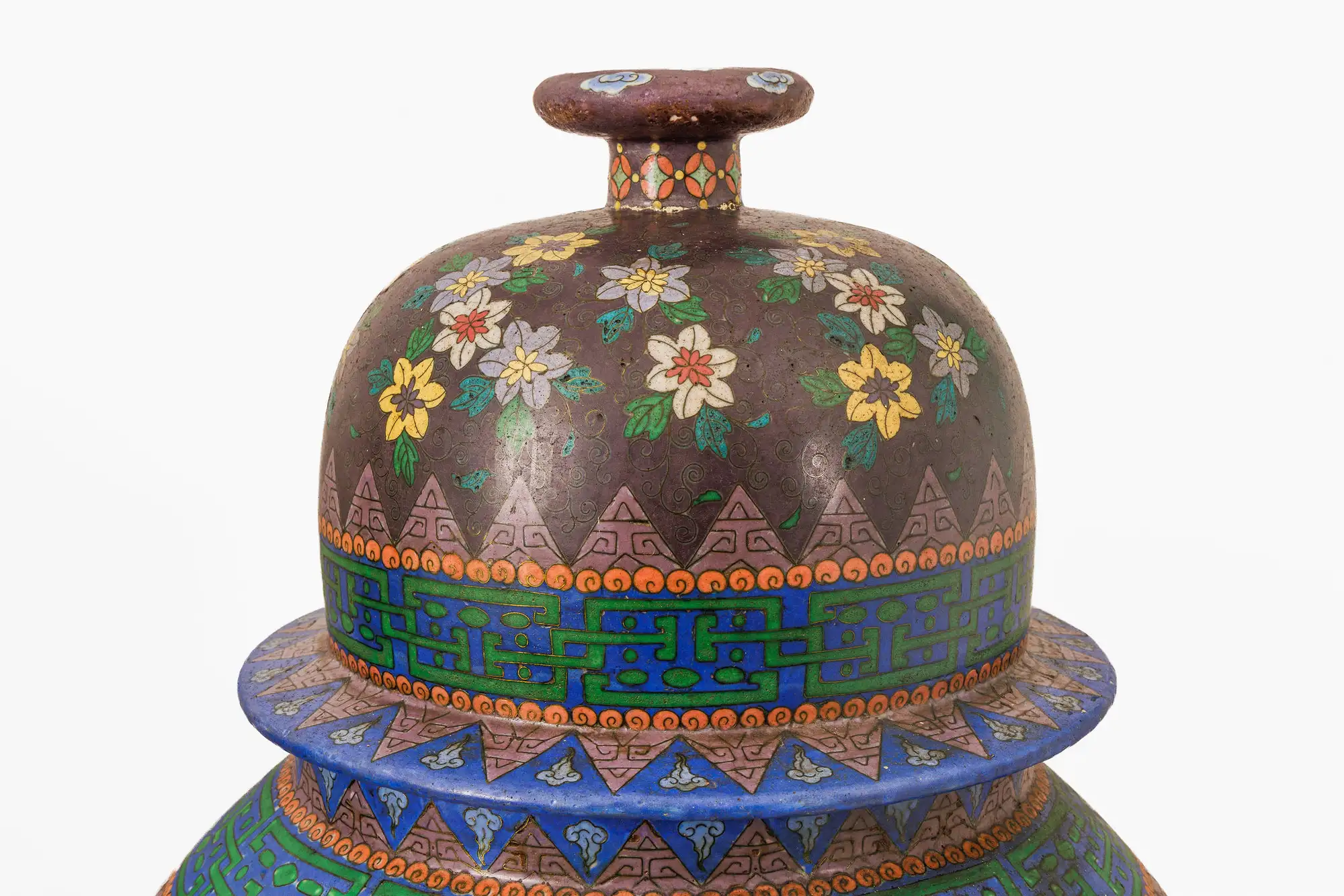
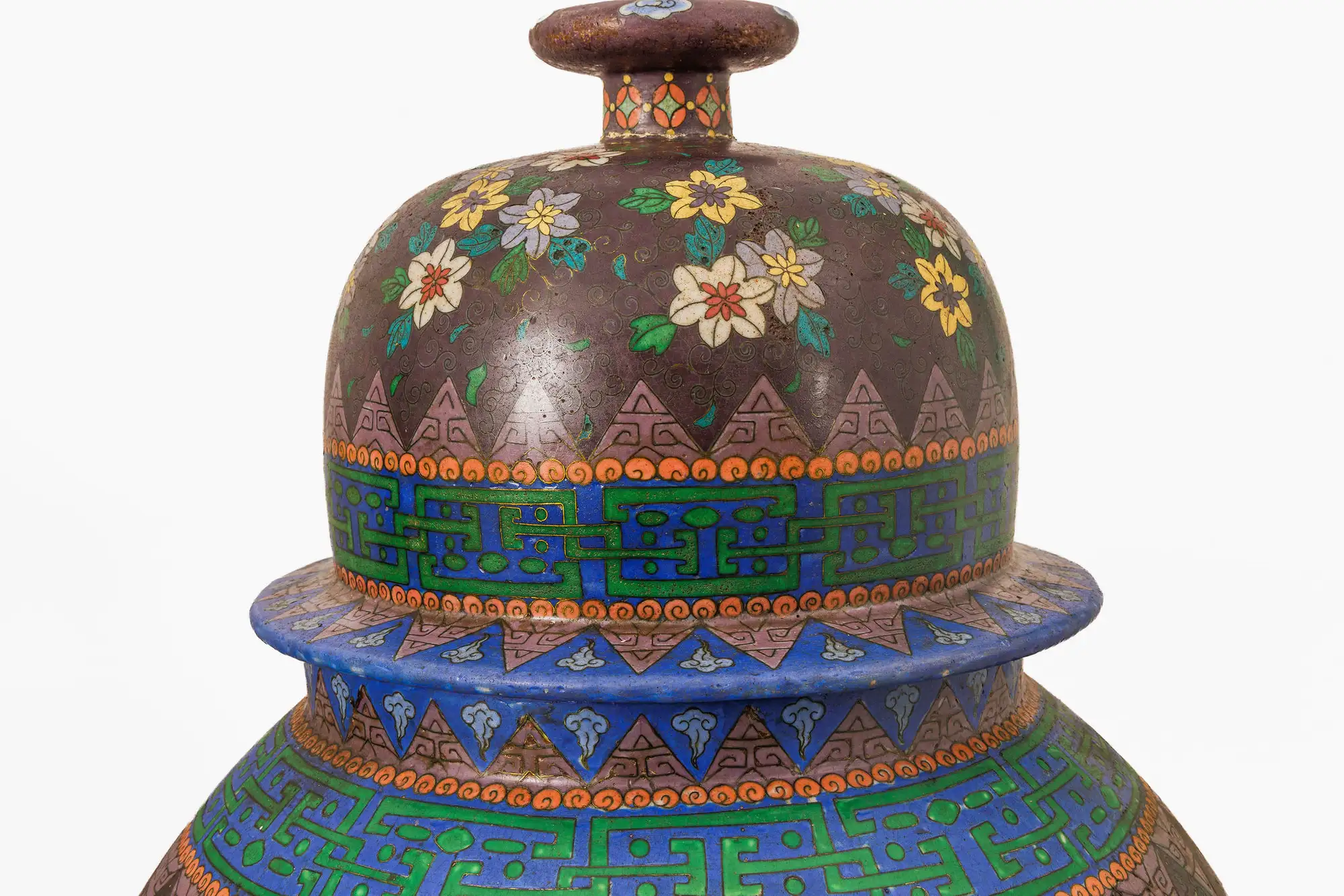
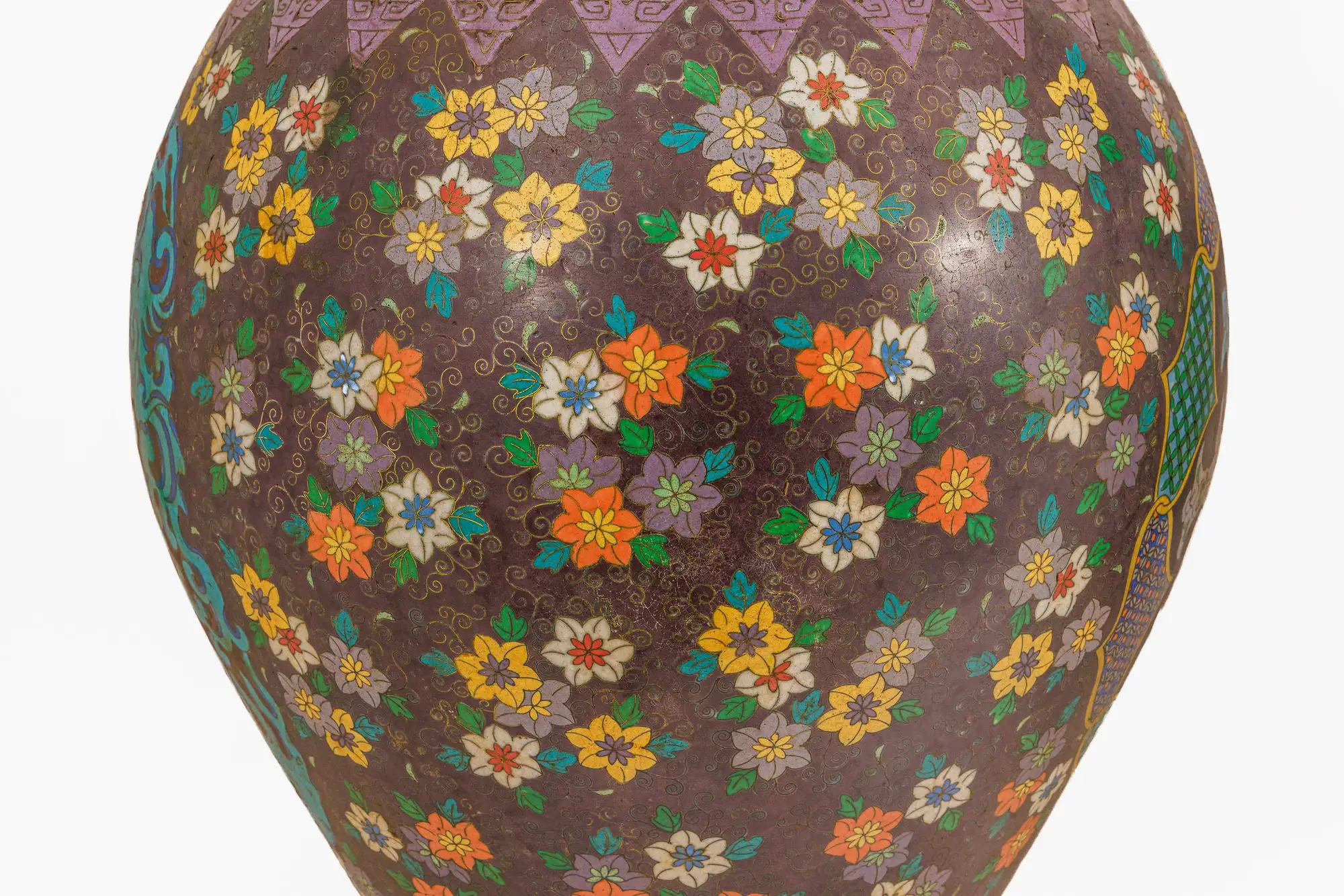
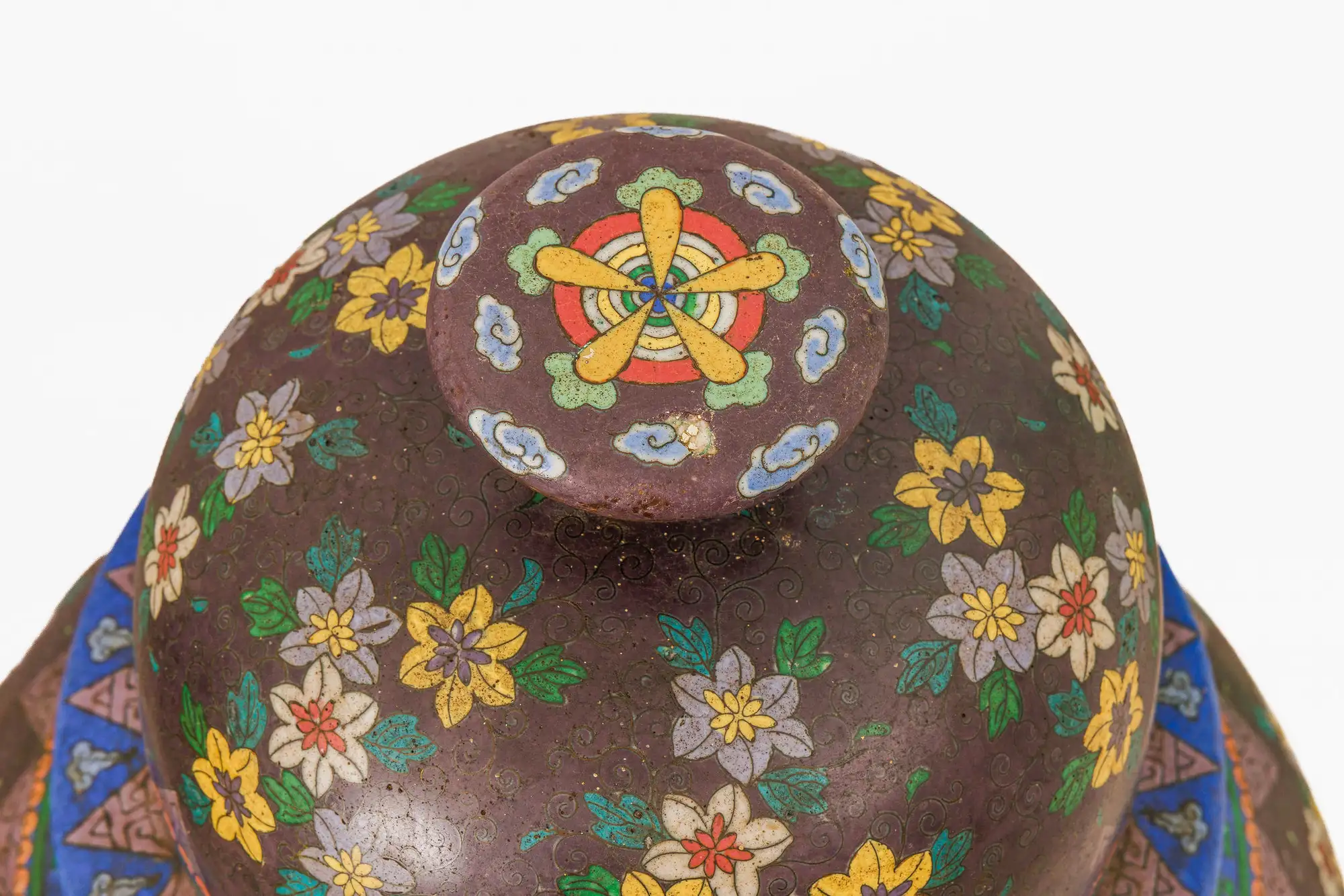
- Each jar is of imposing ovoid form, rising to pronounced shoulders and a short cylindrical neck, surmounted by an elaborate domed cover with a projecting rim and distinctive flattened finial. Every visible surface is richly decorated with exceptionally intricate cloisonné enamelwork, combining naturalistic floral ornament with sophisticated geometric patterns and elaborate architectural borders.
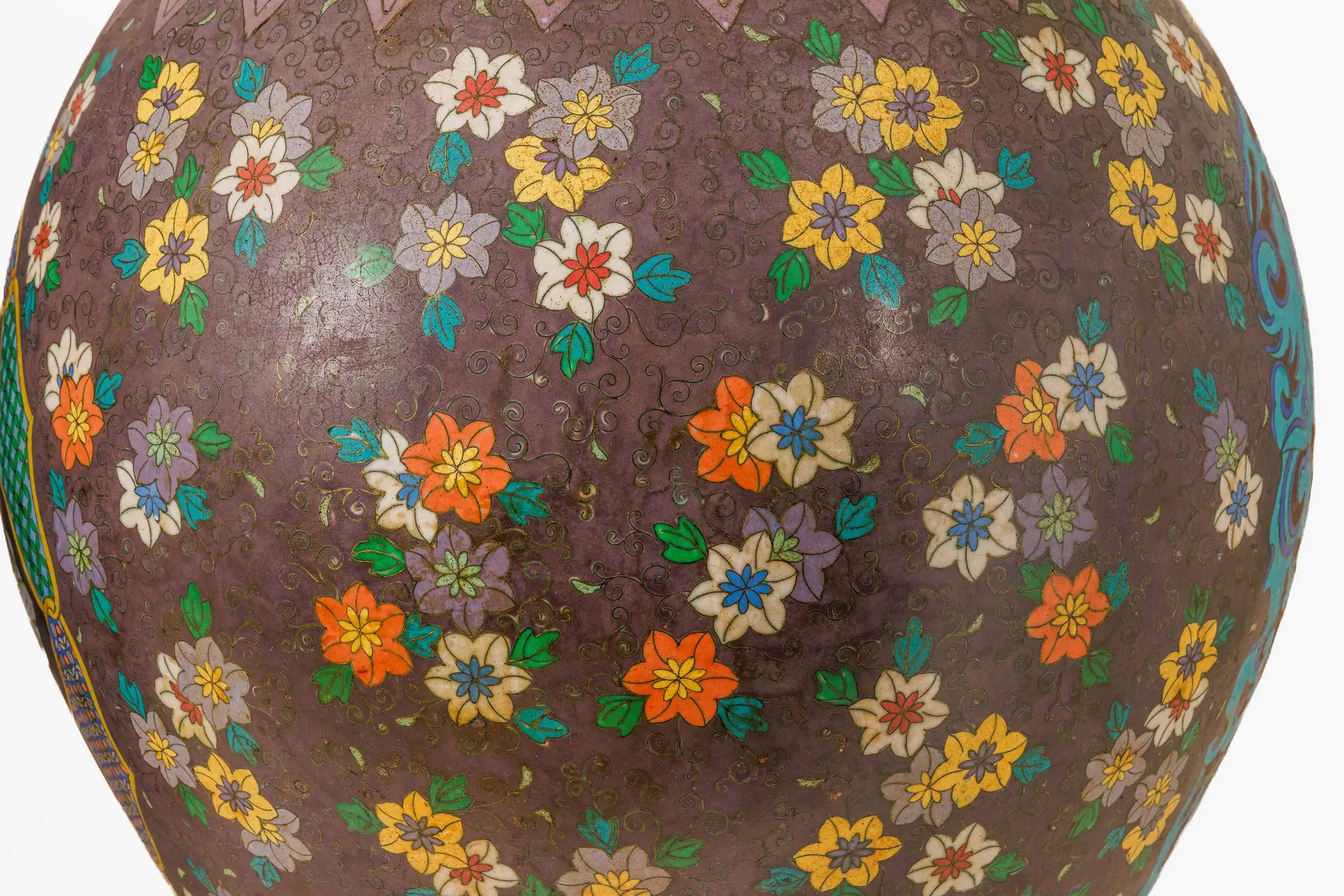
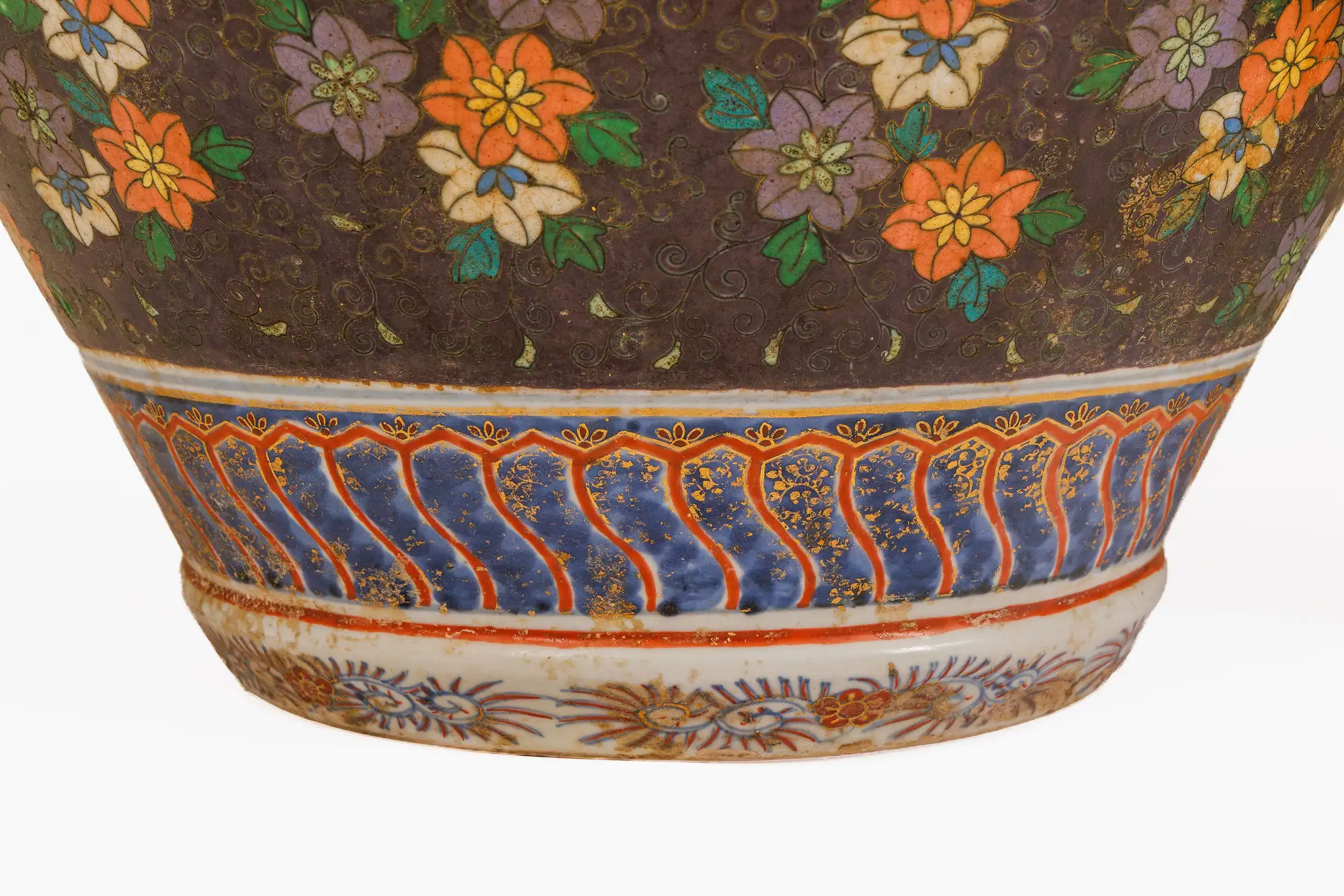
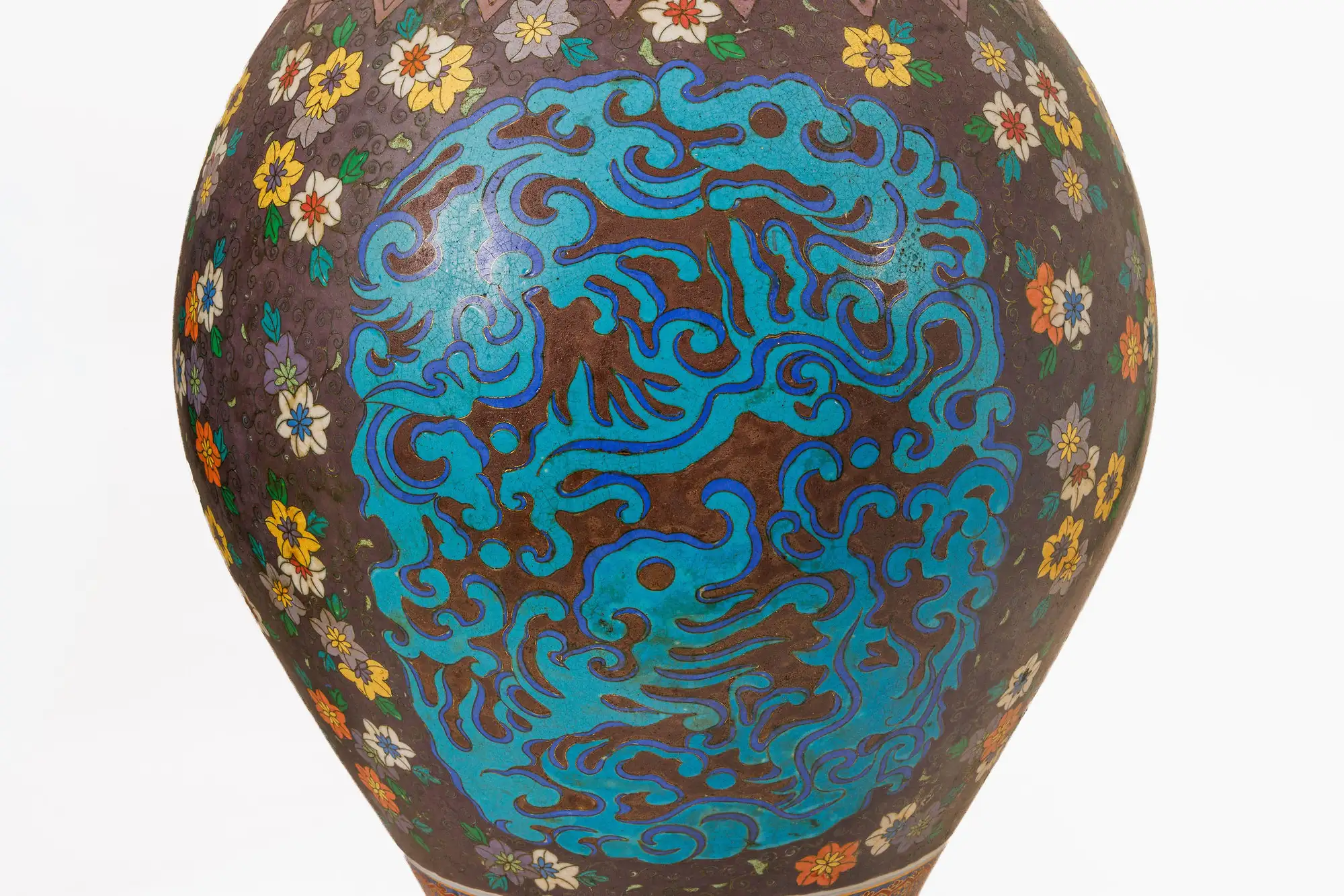
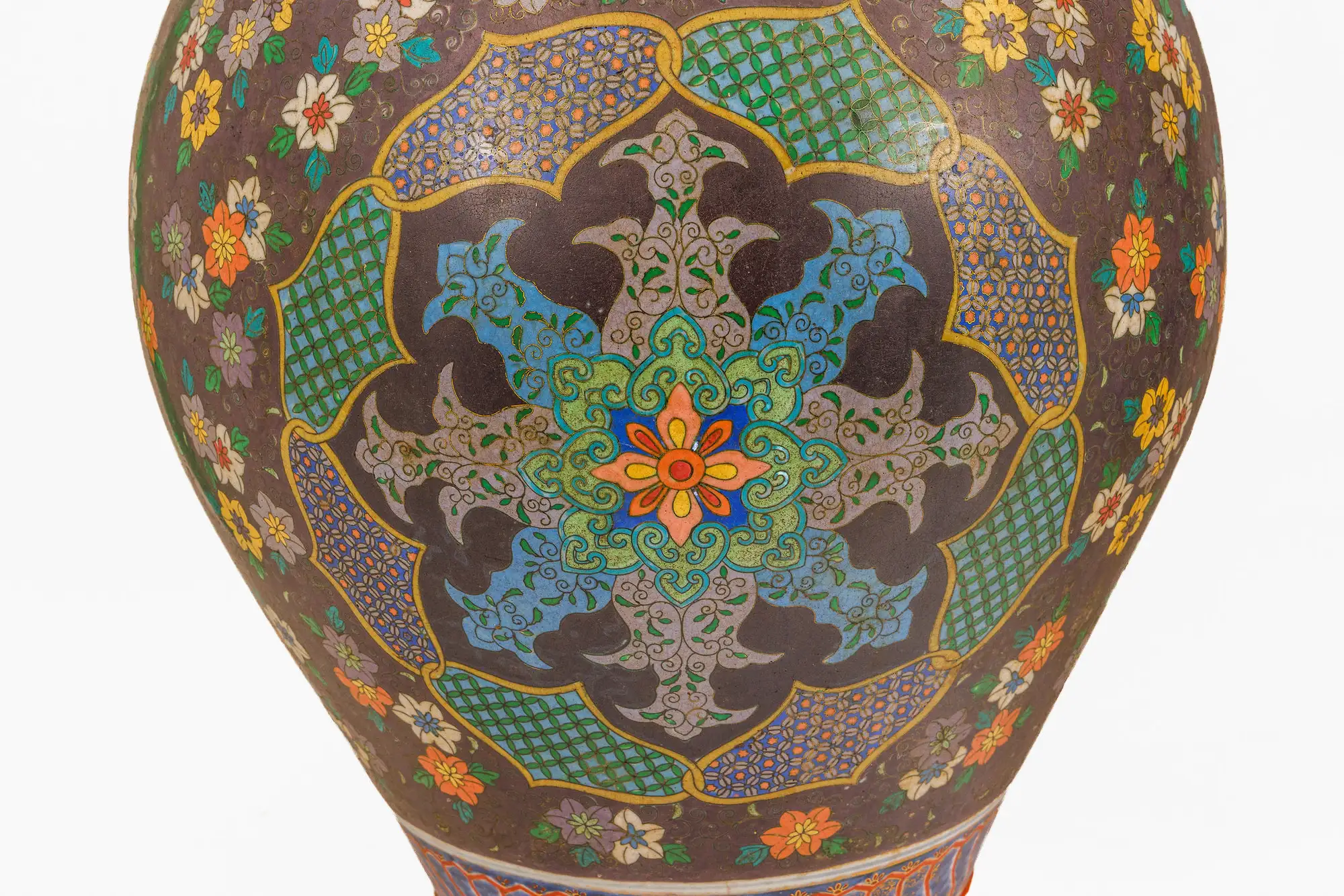
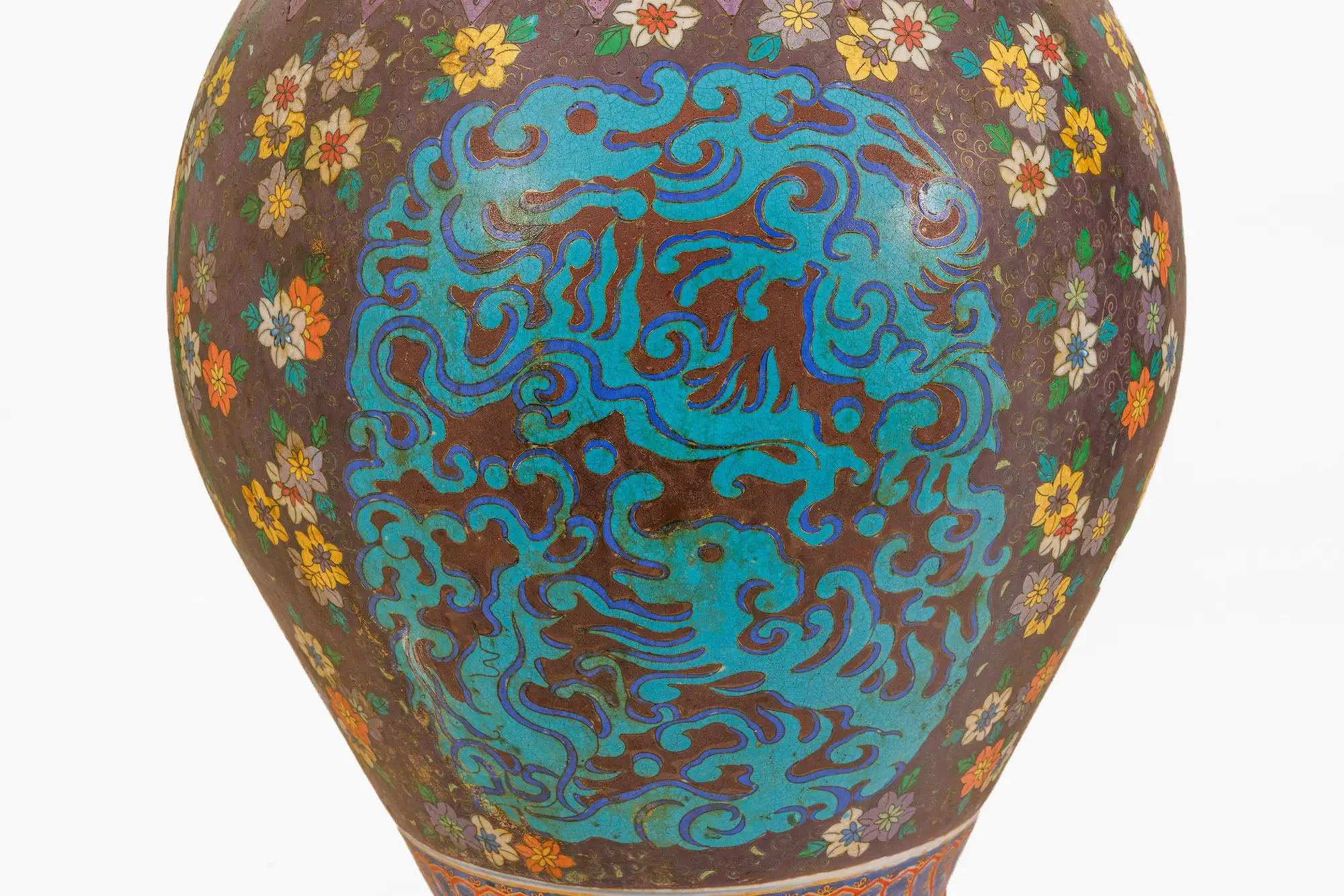
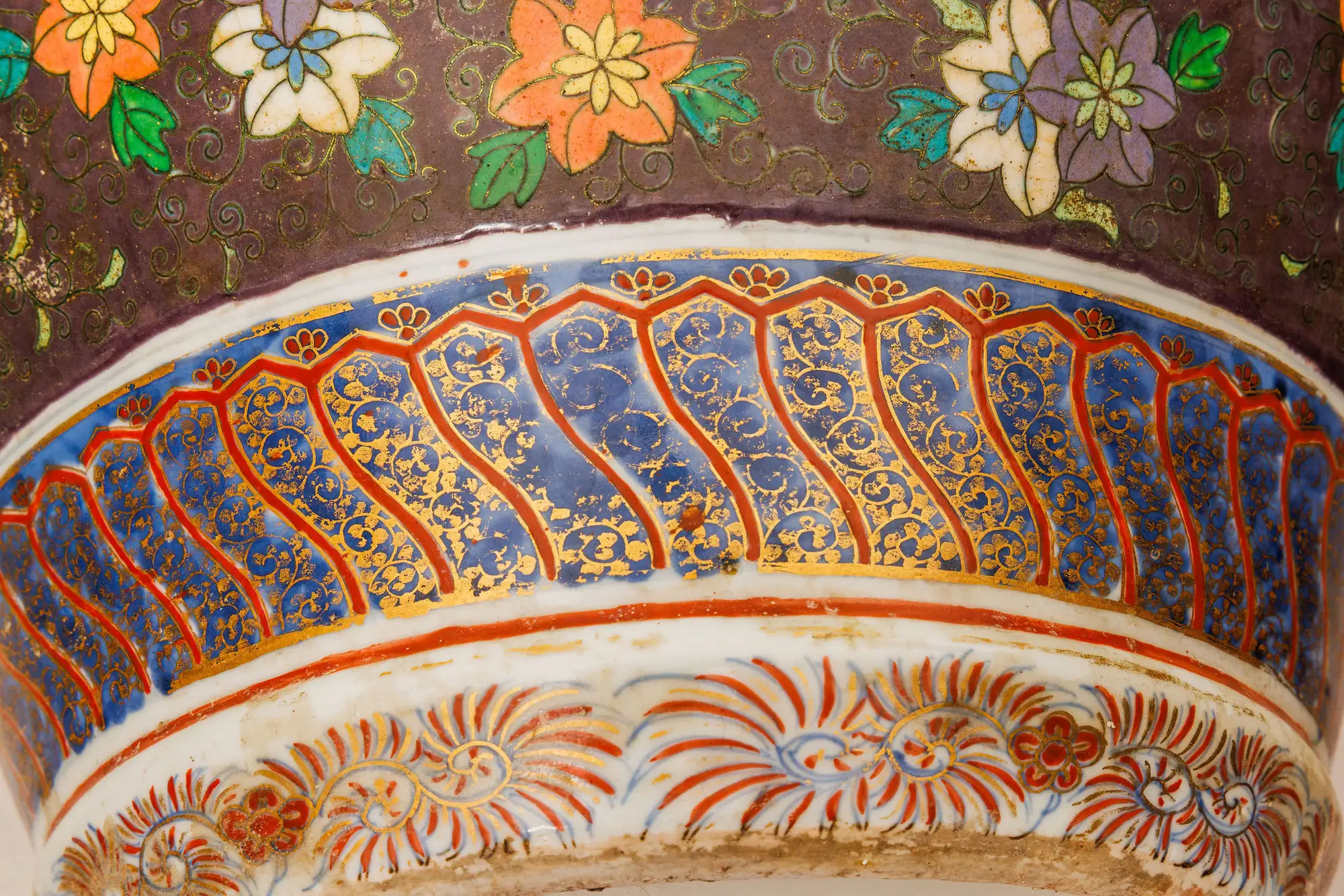
- The principal bodies are covered in delicate polychrome floral sprays against a rich aubergine-brown ground, with blossoms in shades of yellow, white, orange, lavender, and pale blue, interspersed with brilliant turquoise and emerald-green foliage. The flowers are surrounded by an intricate network of scrolling tendrils, creating a remarkably harmonious decorative composition.
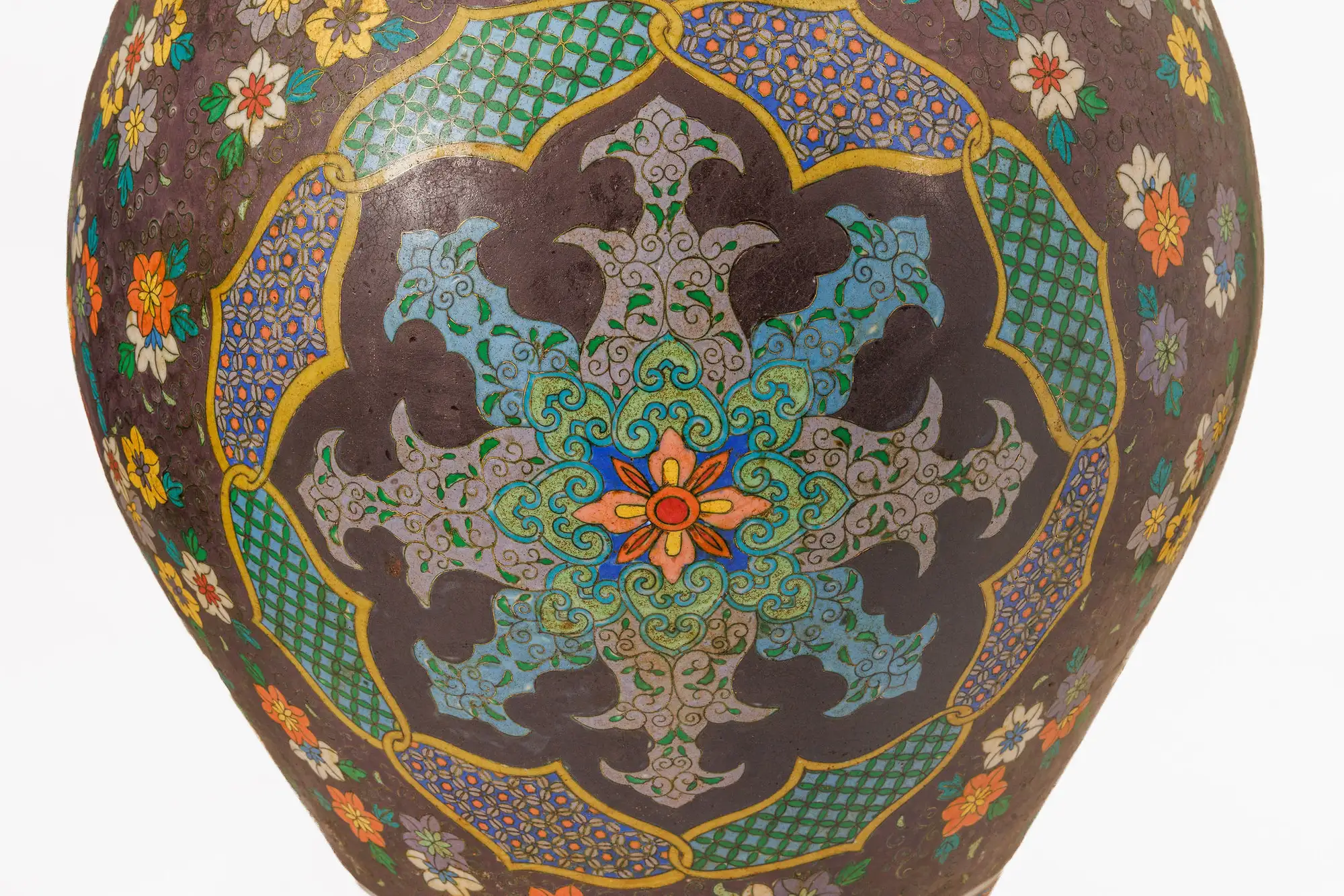
- Dominating the principal faces are magnificent ornamental medallions outlined in yellow enamel, incorporating alternating sections of emerald-green latticework and cobalt-blue geometric patterns. These elaborate reserves frame symmetrical compositions of scrolling arabesques, stylized foliage, and floral motifs in turquoise, pale blue, coral, white, and green.
- Particularly striking are the large turquoise and cobalt-blue scrolling ornaments appearing on the sides of the jars, which bear compelling stylistic similarities to documented examples associated with Takeuchi Chubei and the Shippo Gaisha.
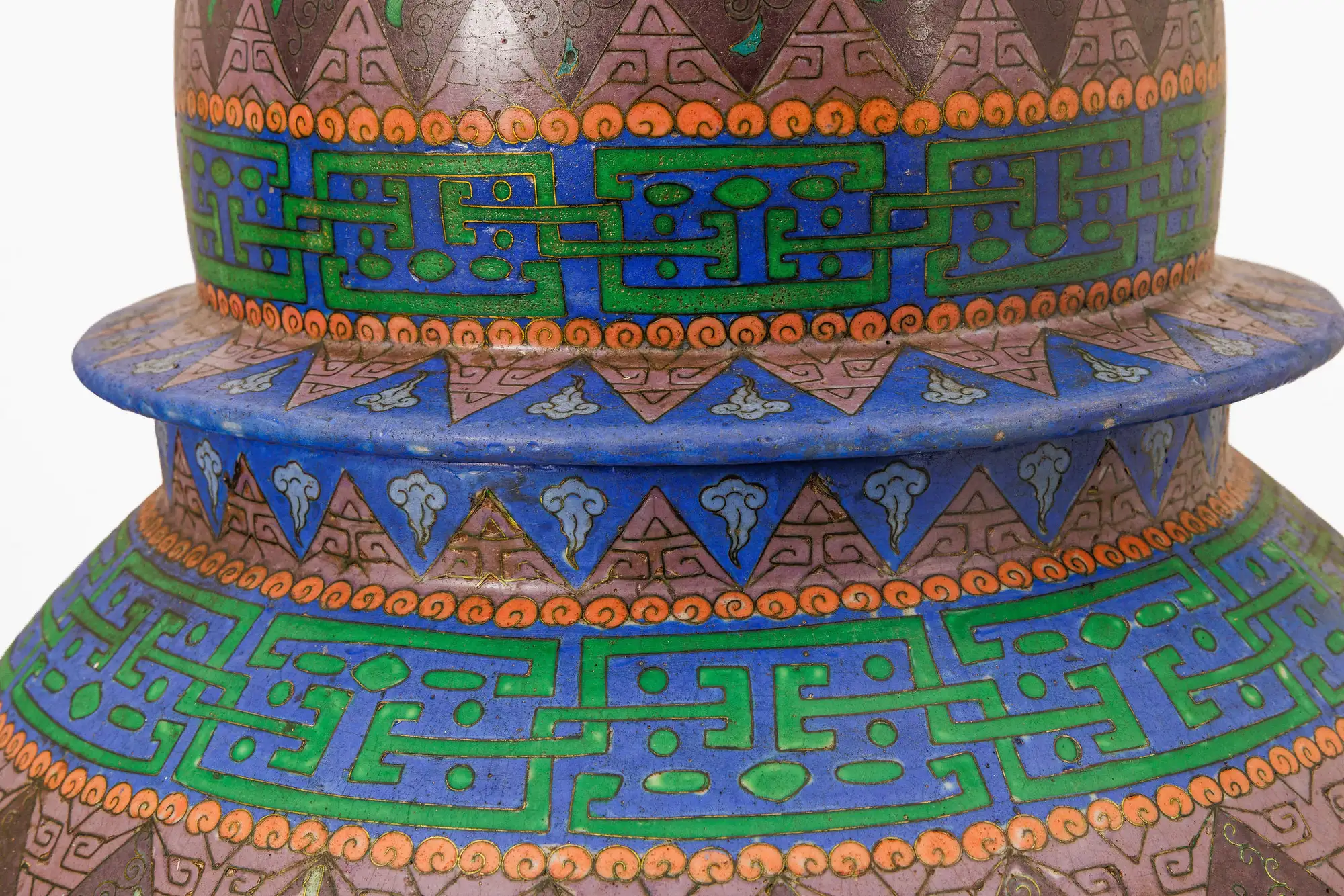
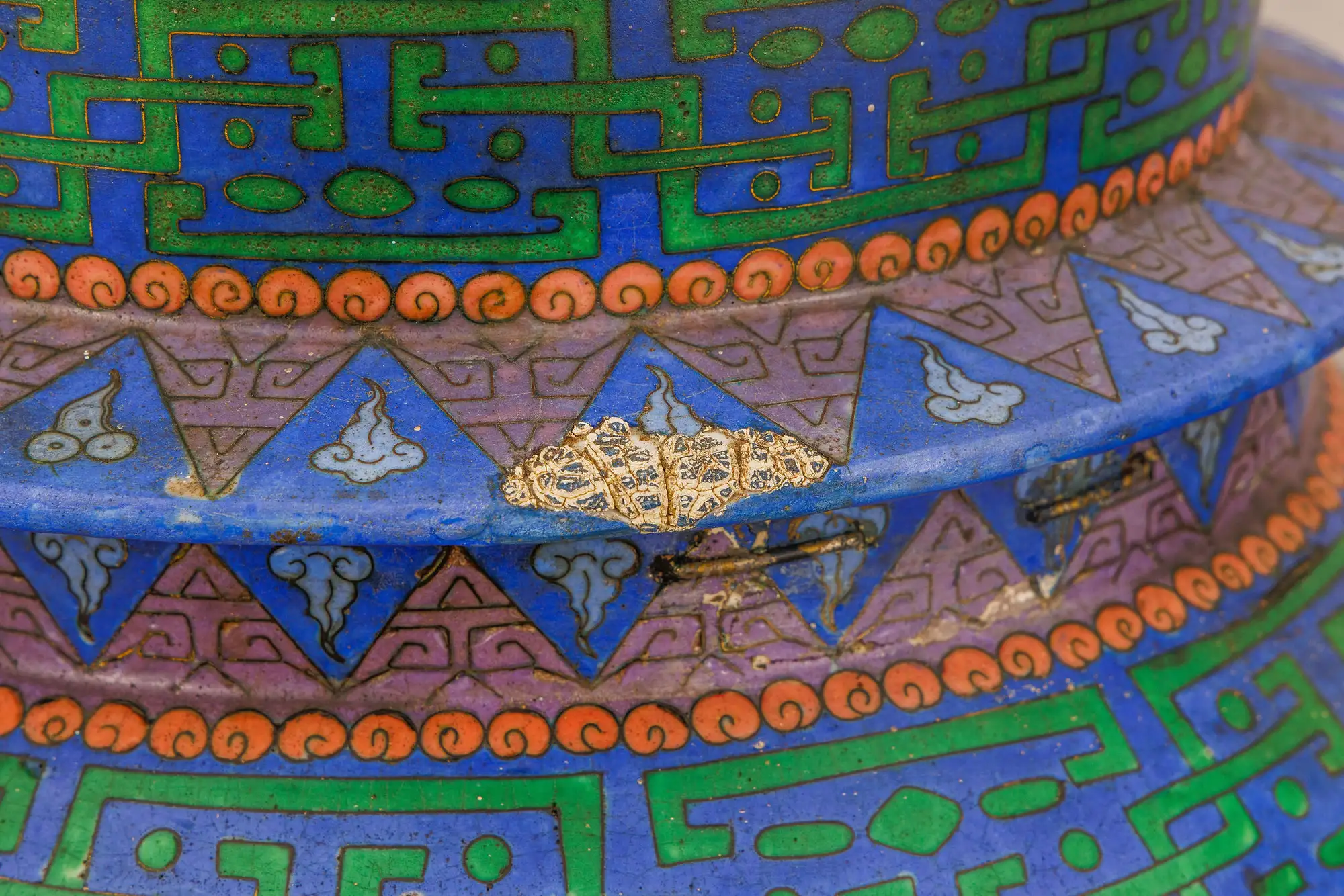
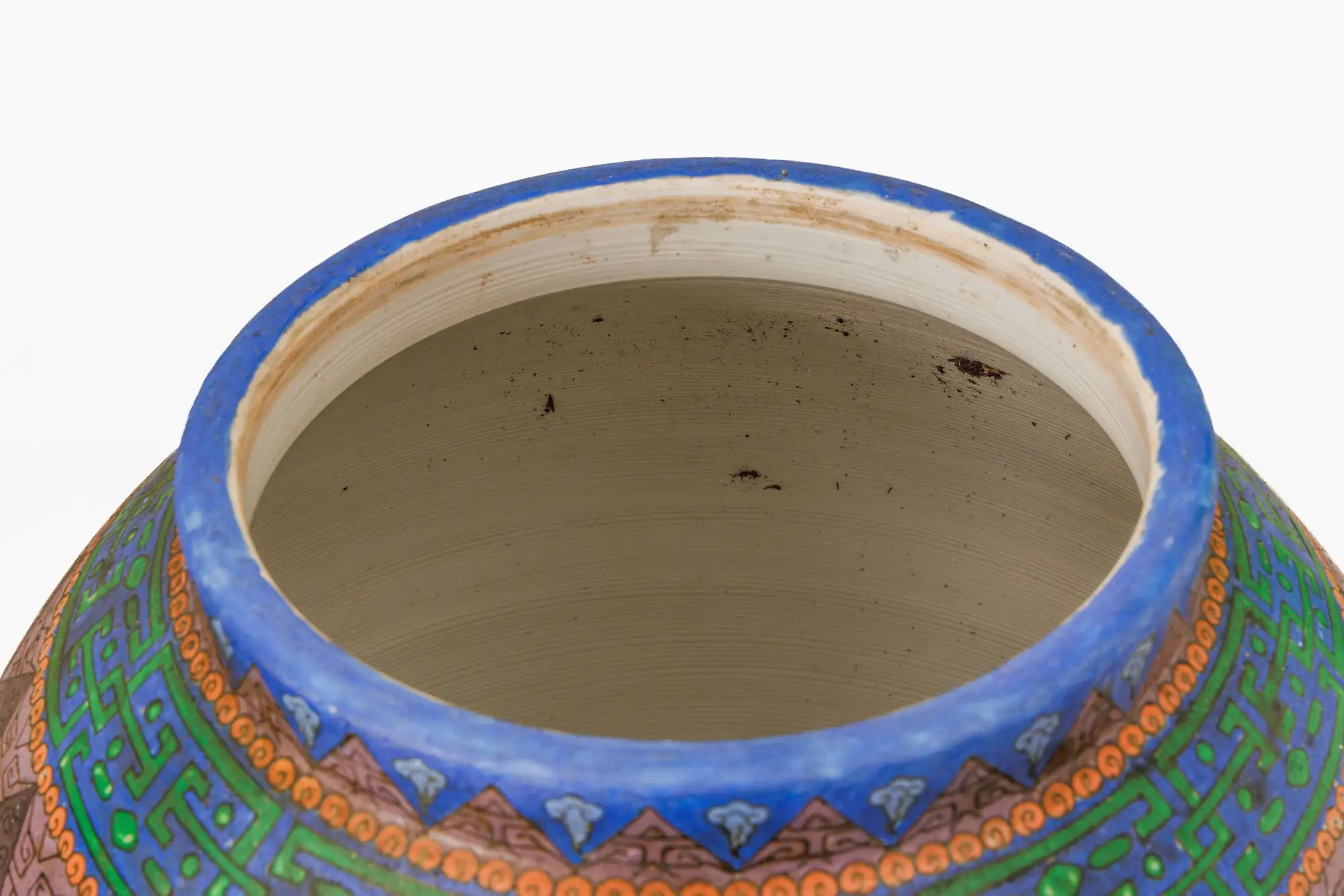
- The shoulders, necks, and covers are enriched with exceptionally complex geometric borders incorporating interlocking fretwork, repeating triangular patterns, and delicate spiral ornament. Even the flattened finials are individually decorated with multicolored floral motifs, demonstrating the extraordinary attention devoted to every detail.
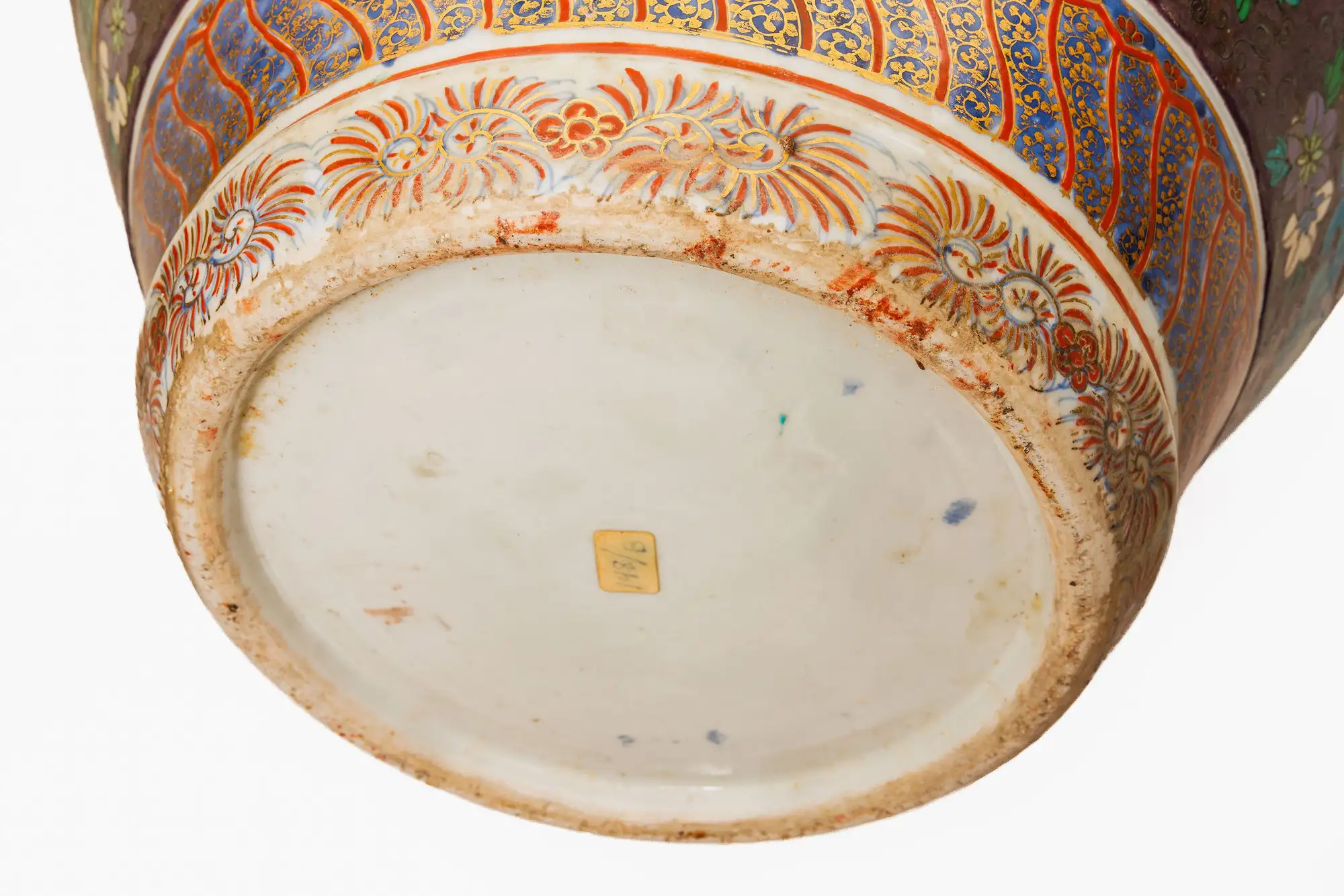
- The monumental scale, remarkable complexity of decoration, and unusual porcelain construction make this pair an outstanding example of jitai shippo (磁胎七宝), the technically demanding Japanese art of cloisonné enamel applied to porcelain rather than the more conventional metal foundation.
- Attribution to Takeuchi Chubei and the Shippo Gaisha:
- Takeuchi Chubei was an important Japanese enameler active during the Meiji period, particularly associated with the production of cloisonné enamel on porcelain.
- This specialized technique required close collaboration between porcelain manufacturers and master enamelers, with ceramic bodies produced in centers such as Seto and subsequently decorated with intricate wire-defined enamelwork in the Nagoya region.
- The attribution of the present monumental pair to Takeuchi Chubei is supported by significant stylistic and technical comparisons with signed examples offered at Christie's and documented works preserved in important Japanese and American museum collections.
- Of particular importance is a rare pair of cloisonné enamelled porcelain vases offered at Christie's, Japanese Craftsmanship: Art of the Meiji Period, Lot 86, bearing the signature Dainihon seizo Shippo gaisha kojin Takeuchi Chubei.
- The Christie's pair, measuring approximately 35.7 cm in height, incorporates elaborate scrolling motifs, stylized flowers, and richly colored geometric ornament. The distinctive decorative vocabulary bears particularly compelling similarities to the present monumental jars, especially the large turquoise and cobalt-blue scrolling compositions.
- A further important comparison is a signed cloisonné enamelled Arita porcelain vase offered at Christie's, measuring approximately 58 cm in height and bearing the signature Shippo Takeuchi Chubei. The auction catalogue references a closely related example preserved in the Aichi Prefectural Ceramic Museum, Japan.
- Important Museum Comparisons:
- The significance of Takeuchi Chubei's work is further demonstrated by examples preserved in major institutional collections.
- Tokyo National Museum, Japan
- The museum preserves an important pair of large covered porcelain jars decorated with birds and flowers, dated 1881, with porcelain bodies attributed to Kawamoto Masukichi I (1831–1907) and cloisonné enamel decoration credited to Takeuchi Chubei.
- The museum also holds a covered cloisonné jar associated with the Shippo Gaisha, circa 1877, with an inscription connecting its production to Takeuchi Chubei and Kawamoto Heisuke (Accession G-687).
- involvement in the manufacture of substantial covered jars during precisely the period to which the present pair is attributed.
- Aichi Prefectural Ceramic Museum, Japan
- The museum preserves a substantial Ceramic Cloisonné Jar (陶七宝大壺) by Takeuchi Chubei, dating to the Meiji period and measuring 54.8 cm in height.
- Produced in Nagoya, this important work provides a further institutional comparison for the present pair's unusual technique, ambitious proportions, and elaborate enamel decoration.
- Walters Art Museum, Baltimore
- The Walters Art Museum preserves a Japanese cloisonné enamel on porcelain vase by Takeuchi Chubei, circa 1880 (Accession 49.2821).
- The museum's provenance documentation includes a qualified historical association with the Centennial International Exhibition held in Philadelphia in 1876, further demonstrating the international significance of this specialized form of Japanese craftsmanship.
- Historical Comparison: Philadelphia Centennial Exhibition, 1876:
- Of particular historical interest is the striking similarity between the distinctive form of the present covered jars and a Japanese covered jar visible in a contemporary photograph of the Japanese display at the 1876 Centennial International Exhibition in Philadelphia.
- The photographed example exhibits a closely comparable silhouette, including its substantial rounded body, pronounced shoulders, domed cover, and unusual flattened finial.
- Japan's participation in the Philadelphia Centennial Exhibition was an important milestone in the international recognition of Japanese decorative arts, introducing Western audiences to extraordinary achievements in ceramics, enamels, lacquerwork, and metalwork.
- Although direct exhibition provenance for the present pair has not been established, this historical comparison provides valuable context for their unusual design and places them within the tradition of ambitious Japanese decorative objects produced for international appreciation during the early Meiji period.
- Artistic and Historical Significance:
- The production of monumental cloisonné enamel on porcelain represents one of the most technically innovative and artistically ambitious developments in nineteenth-century Japanese decorative arts.
- The present pair is particularly distinguished by its imposing scale, remarkable consistency of decoration, extraordinary range of enamel colors, and sophisticated integration of floral, geometric, and arabesque ornament.
- At nearly 70 cm in height, these jars are substantially larger than several documented examples associated with Takeuchi Chubei, including works preserved in museum collections and previously offered at major international auctions.
- Their survival as a monumental matched pair further enhances their importance and decorative presence.
- The compelling comparisons with signed Christie's examples, documented works in the Tokyo National Museum and Aichi Prefectural Ceramic Museum, and historical material associated with the 1876 Philadelphia Centennial Exhibition provide a substantial stylistic and historical foundation for their attribution to Takeuchi Chubei and the Shippo Gaisha, although definitive authorship remains unconfirmed.
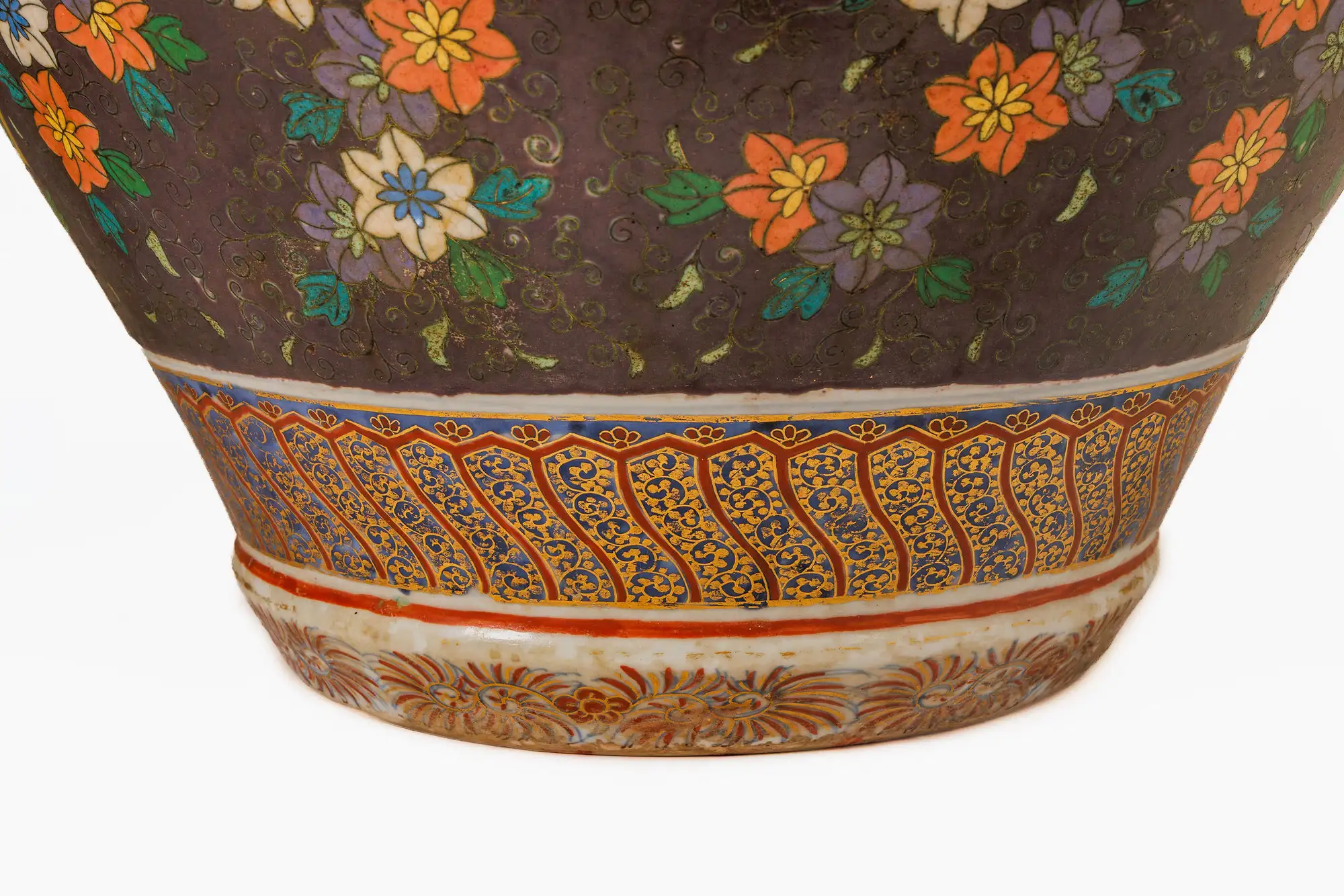
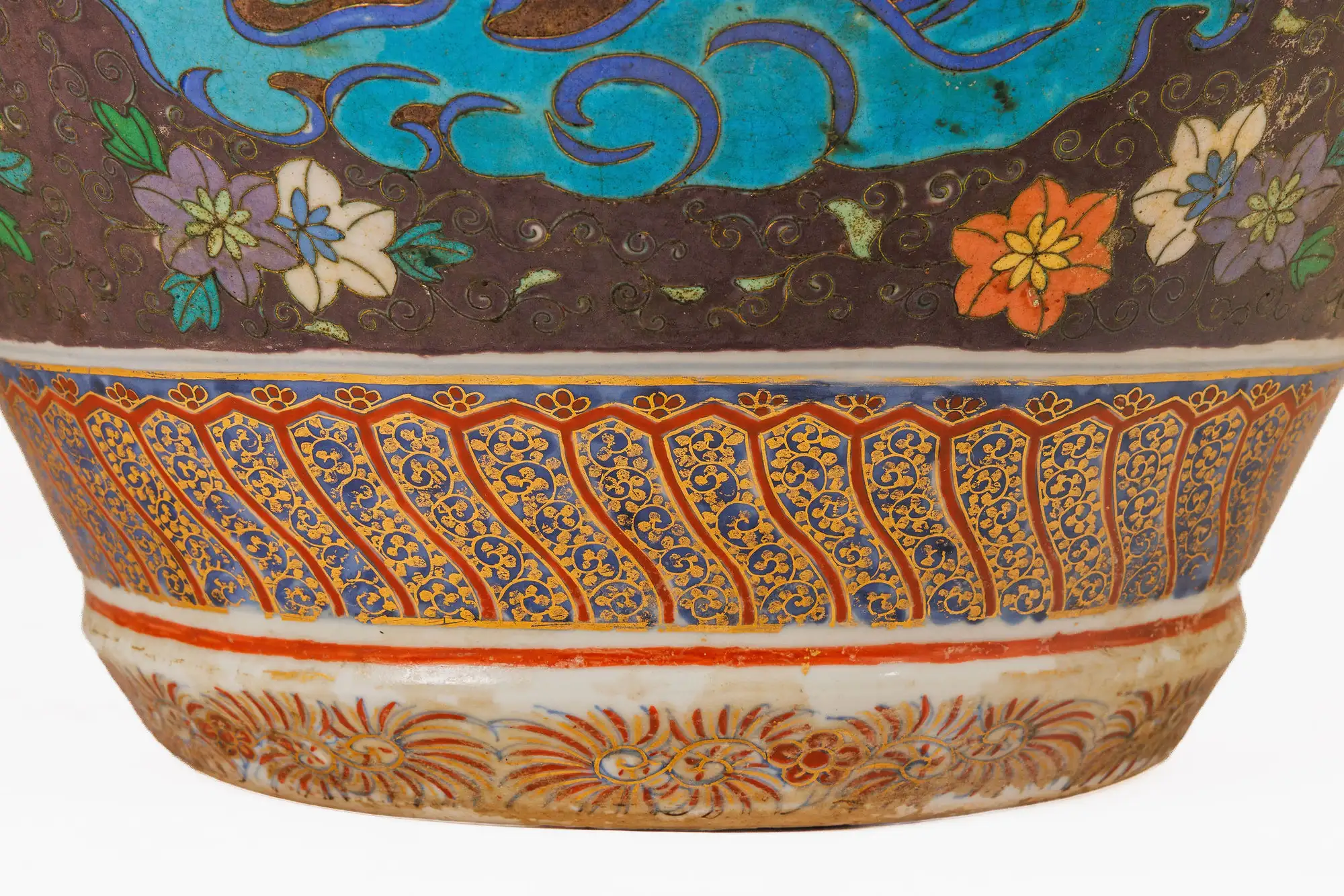
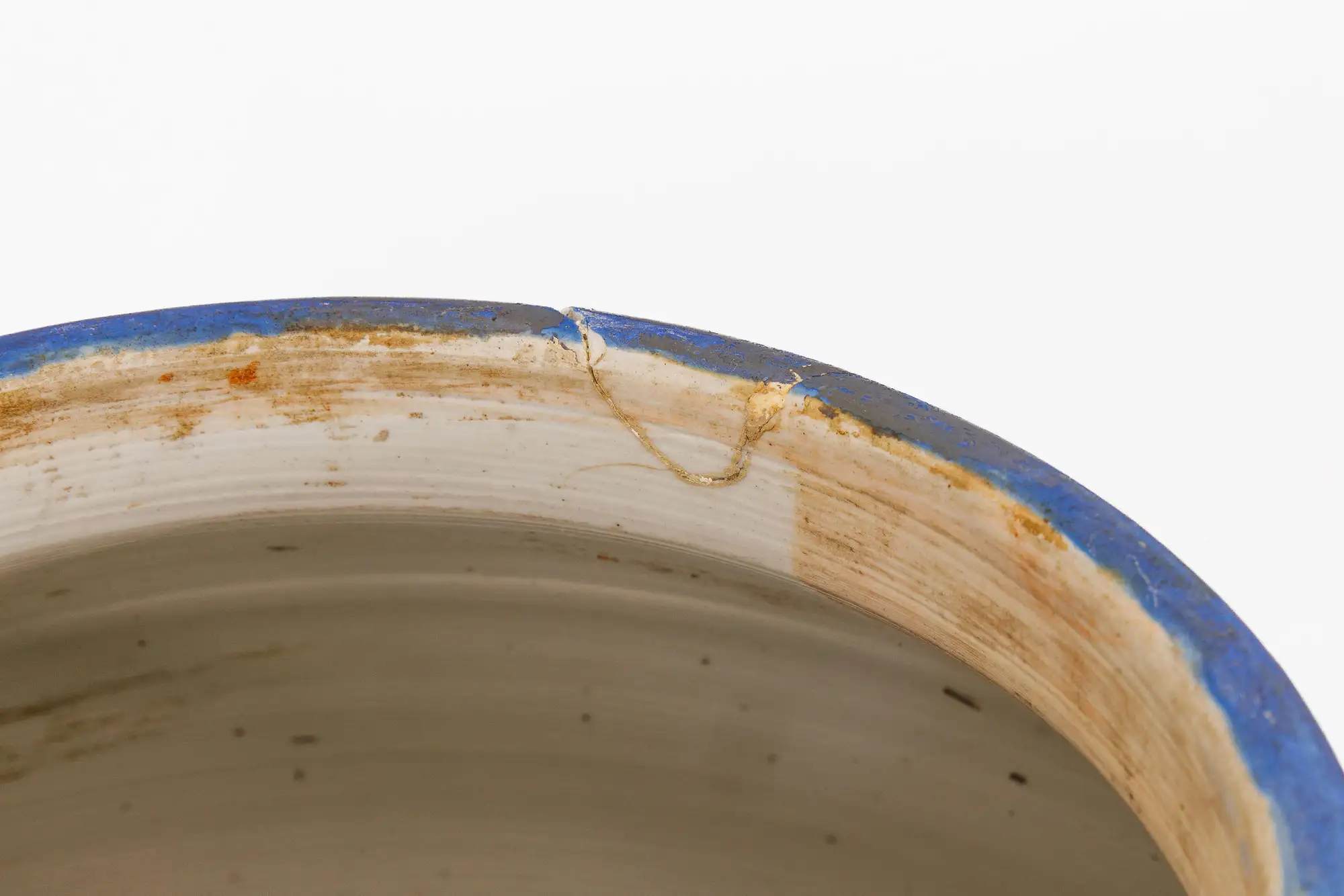
- The covered jars are in very good antique condition, with minor historical restorations consistent with their age and monumental scale. One cover has a small area of restoration believed to date to the 1920s, and the finial on one cover has been professionally reattached. One jar also retains a small, old staple repair to the rim, visible in the accompanying photographs. These restorations are relatively minor in relation to the overall size and importance of the pair and do not detract from their exceptional beauty, decorative presence, or historical significance.
- 28" high x 17" diameter
Period
19th Century
Sold As
Set of 2
Style
Meiji
Origin
Japan
Depth
18 (45.72 cm)
Width
18 (45.72 cm)
Height
28 (71.12 cm)
Attributed To
Meiji-period enameler Takeuchi Chubei (竹内忠兵衛)
Date of Manufacture
19th Century
Materials & Techniques
Enamel,Porcelain
Condition
GoodWear consistent with age and use.
Price Range
◆
Price Range
◆ Under $5,000
◆ $5,000–$10,000
◆ $10,000–$25,000
◆ $25,000–$50,000
◆ $50,000–$100,000
◆ Over $100,000